Table of Contents

Biography

Bibliography

Articles & Book Reviews By

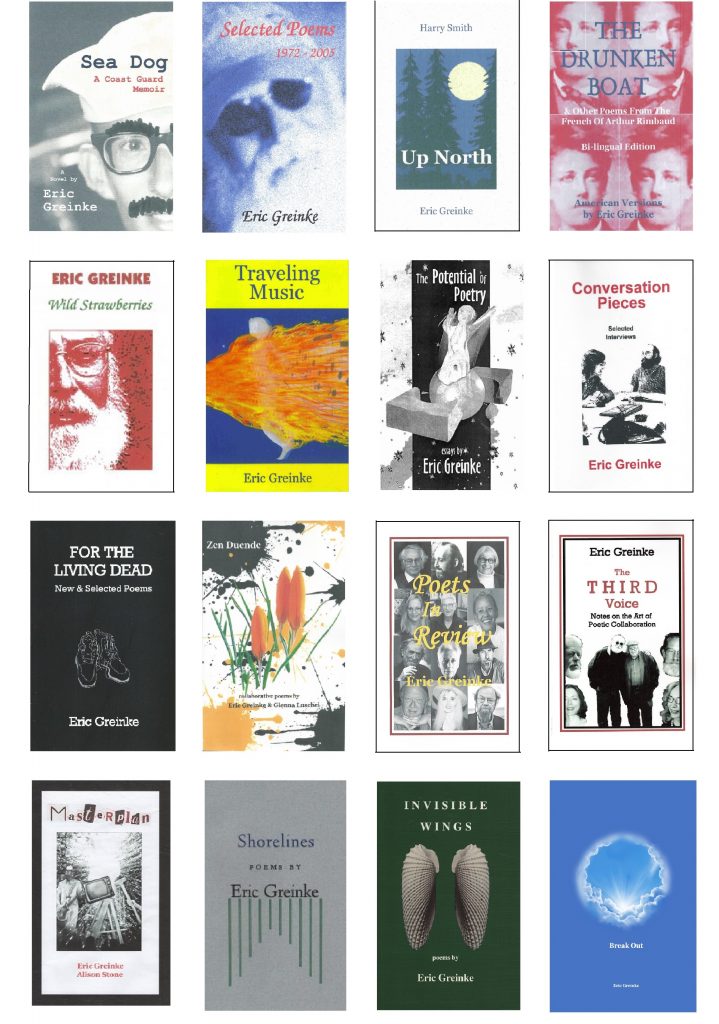
Current & Available Books In Print

Book Excerpts

Critical Comments

Articles & Interviews About                      


Book Ordering Information   


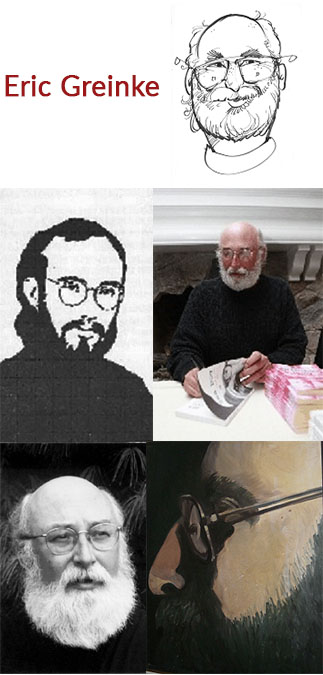
                                                                                                                                                                                Top (l to r): Recent Photo; w/ Hugh Fox        

                                                                                                                                                                                   Middle: Reading w/ Dave Cope; w/ Duane Locke & Ben Tibbs

                                                                                                                                                                                 Bottom: Recent Photo; w/ Jared Smith


Biography

Born, July 15, 1948, Grand Rapids, Michigan. Kelloggsville High School, Wyoming, Michigan, 1966. United States Coast Guard, 1966 through 1968. B.A. in English, Grand Valley State University, 1971. Editor and founder, GVSU national literary magazine Amaranthus, issues 1-7. Editor & Publisher, Pilot Press Books, 1971 through 1976. Fellowship, 1st National Poetry Festival, 1971. 1970's poetry workshops with Ted Berrigan, Paul Blackburn, Robert Bly, Gregory Corso, Robert Creeley, Allen Ginsberg, Jerome Rothenberg, Jackson MacLow and Philip Whalen, among others. Book reviewer, The Grand Rapids Sunday Press, 1971 through 1979. Creative writing teacher, Grand Rapids City High School, 1974-1975. Poets-In-The-Schools Program, Michigan Council for the Arts, 1975-1976. Assistant Manager, B. Dalton Booksellers, 1975 through 1979. B.A. in Psychology, Sociology Minor, Grand Valley State University, 1976. Social Worker at St. John's Home For Emotionally Disturbed Children, Grand Rapids, Michigan, 1979. Social Worker, Riverview Residential Treatment Facilities, 1979 through 1990. M.S.W. in Clinical Social Work, Grand Valley State University, 1981. Certified Social Worker, State of Michigan, since 1981. Social Worker, Kent Client Services, 1990 through 1994. Master Angler Awards, Michigan Department of Natural Resources, 1995, 1997, 2000, 2001 (2), 2002 (3), 2003 (3), 2004. Nominated for six Pushcart Prizes, 2006 (2), 2007 (2), 2008 (2).  His poem For The Living Dead received the Muses Review Best Poem of Year 2007 Award.  Member, Academy of American Poets.  He lives in a century-old cottage by a northern lake with his wife Roseanne and son Karl (17).  He also has an adult son, Kris, and daughter, Anna.

Bibliography

Poetry Magazines & Anthologies

Eric Greinke's work has appeared or been accepted for publication in the following literary magazines & anthologies to date . For any omissions to this list, our apologies.

Abbey, Air, The Alcaeus Review, Amaranthus, The Ambassador Poetry Project, Backwards City Review, Barbaric Yawp, Bathtub Gin, Beatlick News, Big Scream, Bitterroot, Bogg, Boston Area Small Press and Poetry Scene, Brown Penny Review, California Quarterly, The Cape Rock Journal, The Cedar Rock Quarterly, Chiron Review, Clark Street Review, Cloven Hoof, Creative Moment, The Detroit Free Press, Display, Drama Garden, Edgz, Emphasis, Essence, Fly By Night, For The Time Being, Free Lance, Free Verse, The Goodly Co., The Grand Rapids News, Grand Valley Today, Great Art, Happiness Holding Tank, HazMat Review, Home Planet News, The Hurricane Review, Ibbetson Street, Iconoclast, Illogical Muse, King James Version, The Lanthorn, Lazarus, The Mad Poets Review, Main Channel Voices, Main Street Rag, Magazine Six, The Margarine-Maypole Orangoutang Express, Metamorphosis, Midnight, Muses Review, Napalm Health Spa Report, Nerve Cowboy, New Dimensions, The New York Quarterly, Once Again, Out Of Sight, The Pedestal Magazine, Pegasus, Poetry Americana, PoetsWest, Presa, The Roadrunner Haiku Journal, The Root, The Small Press Review, Solo Cafe, The Somerville News, The South Carolina Review, Stone Drum, Tar Wolf Review, Tertulia, The 13th Warrior Review, Under The Banana Tree (League of Laboring Poets), The United Co-Operative, The University of Tampa Review, The Unrorean, Wavelength, WestWard Quarterly, Wilderness House Literary Review, Wild Goose Poetry Review, The Wild Plum Review, Wild Violet, The Woodsrunner & Words Of Wisdom..

Anthology of Contemporary American Poetry (Maurice Custodio, editor, Peace and Pieces Press, San Francisco, CA,1972), Being '71 (Cor Barendrecht, editor, Being Press, Grand Rapids, MI,1971), Best Of Four (Walter Lockwood, editor, Dyer-Ives, Grand Rapids, MI,1971), For Neruda / For Chile (Walter Lowenfels, editor, Beacon Press, Boston, MA,1975), Inside The Outside: An Anthology Of Avant-Garde American Poets (Roseanne Ritzema, editor, Presa Press, Rockford, MI, 2006), Mantras (Alan Britt, editor, Floating Hair Press, Tampa, FL,1973), Michigan Hot Apples (Gay Rubin, editor, Hot Apples Press, Bloomfield Hills, MI, 1972), Michigan Hot Apples 2 (Gay Rubin, editor, Hot Apples Press, Bloomfield Hills, MI,1973), 10 Michigan Poets (Eric Greinke, editor, Pilot Press Books, Grand Rapids, MI,1972), Midwest Poetry 1972 (Roy Burrows, editor, Burro Books, El Dorado, AK,1972), Themes 2003 (Brigitta Getrich, editor, Creative With Words, Carmel, CA, 2003), The Vagaries Of Invention (Donald Isaacson & Helen Sheridan, editors, Sidewinder Press, Kalamazoo, MI, 1982), Wilderness House Literary Review Volume 1 (Gloria Mindock, editor, ISCS Press, Littleton, MA, 2007.)


  Books

- SAND & OTHER POEMS (Metamorphosis Press, 1971. 60 pages, Hardcover, 1000 copies. Out-of-Print.)

- CAGED ANGELS (Pilot Press Books, 1972. 64 pages, Trade Paperback, 1000 copies. Out-of-Print.)

- 10 MICHIGAN POETS (Pilot Press Books, 1972. 154 pages, Trade Paperback, 5000 copies. Out-of-Print.)

- THE LAST BALLET (Pilot Press Books, 1972. 72 pages, ISBN 0-88324-004-1. Trade Paperback, 500 copies, ISBN 0-88324-005-X. Hardcover, 500 copies, Both Out-of-Print.)

- IRON ROSE (Pilot Press Books, 1973. 48 pages, ISBN 0-88324-054-8. Hardcover, 1000 copies. Out-of-Print.)

- MASTERPIECE THEATER (With Brian Adam, Pilot Press Books, 1975. 64 pages, ISBN 0-88324-045-9. Trade Paperback, 500 copies. Out-of-Print.)

- THE BROKEN LOCK Selected Poems 1960-1975 (Pilot Press Books, 1975. 120 pages, ISBN 0-88324-057-2. Hardcover, 1000 copies. Out-of-Print.)

- THE BROKEN LOCK: New & Selected Poems (Pilot Press Books, 1976. 48 pages, ISBN 0-88324-058-0. Trade Paperback, 1000 copies. Out-of-Print.)

- WHOLE SELF / WHOLE WORLD Quality of Life in the 21st Century (Presa Press, 2004. 120 pages, ISBN 0-9740868-3-5. Hardcover.  1000 copies. Out-of-Print.)

- SEA DOG A Coast Guard Memoir (Presa Press, 2004. 180 pages, ISBN 0-9740868-6-.X Hardcover, ISBN 0-9740868-5-1. Trade Paperback.)

- SELECTED POEMS 1972 - 2005 (Presa Press, 2005. 140 pages, ISBN 0-9740868-8-6. Hardcover, ISBN 0-9740868-7-8. Trade Paperback.)

- THE ART OF NATURAL FISHING (Presa Press, 2003. 96 pages, ISBN 0-9740868-0-0. Hardcover. 1000 copies.   ISBN 0-9772524-6-.9 Trade Paperback.)                                                                                                                                                                     

- THE DRUNKEN BOAT & OTHER POEMS FROM THE FRENCH OF ARTHUR RIMBAUD (Presa Press, 2007. 108 pages, ISBN 978-0-9772524-7-3. Bilngual  edition.Trade Paperback.)                                                                                                        

-WILD STRAWBERRIES (Presa Press, 2008. 96 pages, ISBN 978-0-9800081-1-1.Trade Paperback.)

Chapbooks

- EARTH SONGS (Metamorphosis Press. 1970. 40 pages. 500 copies. Out-of-Print.)

- CANARY WINE (Metamorphosis Press. 1970. 28 pages. 500 copies. Out-of-Print.)

- MILK RUN & OTHER POEMS (Metamorphosis Press. 1971. 28 pages. 500 Copies. Out-of-Print.)

- THE POEM AS CHILD - An Essay (World Of Young Writers. 1971. 12 pages. 100 copies. Out-of-Print.)

- ROSES (Joie Editions. 1973. 16 pages. 100 numbered copies. Out-of-Print.)

- ICE (Joie Editions. 1973. 16 pages. 100 numbered copies. Out-of-Print.)

- THE CYMBAL CRASHES - Poem & Notes (Pilot Press Books. 1973. 16 pages. 500 copies. Out-of-Print.)

- GREAT SMOKY MOUNTAINS (with Ronnie M. Lane. Free Books, Inc. 1974. 28 pages. 500 copies. Out-of-Print.)

- BLACK MILK - Ghazal Sequences (Free Books, Inc. 1974. 16 pages. 500 copies. Out-of-Print.)

- FOR YOU (Pilot Press Books. 1974. 24 pages. 100 numbered copies. Out-of-Print.)

- THE DRUNKEN BOAT & OTHER POEMS FROM THE FRENCH OF ARTHUR RIMBAUD (Free Books Inc., 1975, First Edition, 500 copies, 1976, Second Edition, 500 copies. 36 pages, Third Edition, 500 copies, 48 pages, Presa Press, 2005.)

- SOME TREES - Highly Selected Poems (Privately Printed. 1976. 8 pages. 100 copies. Out-of-Print.)

- MEMORY - Selected Poems 1994 (Privately Printed. 1994. 36 pages. 123 signed & numbered copies. Out-of-Print.)

- A SYMBOLIST MANIFESTO - With An Annotation by Duane Locke (Privately Printed. 2005. 12 pages.)

- UP NORTH (With Harry Smith.  Presa Press. 2006. 40 pages.)

- FOR THE LIVING DEAD  (Free Books, Inc. 2007. 28 pages.) *

- GET IT  (With Mark Sonnenfeld.  Marymark Press. 2007. 20 pages.)

- KAYAK LESSONS  (Free Books, Inc. 2009. 20 pages.)

- CATCHING THE LIGHT - 12 HAIKU SEQUENCES  (With John Elsberg, Cervena Barva Press, 2009. 36 pages.)

*2nd Place 2009 Purple Patch Award winner for Best Individual Collection of the Year. (UK)


Articles & Book Reviews by


Book Reviews


Eric Greinke's Book Reviews for The Grand Rapids Press, 1972-1980

Speech Acts & Happenings by Robert Vas Dias, April 2, 1972, Tuesday Morning Rain Wednesday Morning Love & Thursday Morning by D.E. Stewart, May 14, 1972, A Caterpillar Anthology edited by Clayton Eshleman, May 28, 1972, Shaking the Pumpkin edited by Jerome Rothenberg, June 25, 1972, Smudging by Diane Wakoski, July 23, 1972, Logan Stone by D.M. Thomas, July 30, 1972, The Whispering Wind edited by Terry Allen, August 6, 1972, Mocking-Bird Wish Me Luck by Charles Bukowski, August 20, 1972, The Plentitude We Cry For by Sarah Appleton, September 3, 1972, Poems for Three Decades by Richmond Lattimore, September 17, 1972, Moving by Tom Raworth, October 1, 1972, The Blue Cat by F.D. Reeve, October 15, 1972, The Providings by Carl Thayler, The Revenant by Dan Gerber, Xeme by Rebecca Newth, Accidental Center by Michael Heller, Midwatch by Keith Wilson, October 29, 1972, Helmet of the Wind by Nancy Cardozo, November 26, 1972, A Day Book by Robert Creeley, January 7, 1973, My House by Nikki Glovanni, January 28, 1973, John's Heart by Tom Clark, May 6, 1973, New Work by Joe Brainard, December 16, 1973, The Philosophy of Andy Warhol by Andy Warhol, September 21, 1975, Your Erroneous Zones by Dr. Wayne Dyer, Looking Out for No. 1 by Robert Ringer, March 12, 1978, Four Arguments for the Elimination of Television by Jerry Mander, April 9, 1978, Links by Charles Panati, April 16, 1978, Money Madness: the Psychology of Saving, Spending, Loving and Hating Money by Herb Goldberg and Robert T. Lewis, May 14, 1978, The Psychological Society by Martin L. Gross, June 18, 1978, Catastrophe Theory by Alexander Woodcock and Monte Davis, September 17, 1978, Freud: The Psychoanalytic Adventure by Robert Ariel, October 22, 1978, Person/Planet by Theodore Roszak, December 24, 1978, The Tolkien Scrapbook edited by Alida Becker, December 31, 1978, A Walk Across America by Peter Jenkins, February 11, 1979, Weather Language by Julius Fast, April 1, 1979, The Man Who Rode His 10-Speed Bicycle to the Moon by Bernard Fischman, April 22, 1979, Giant Steps by Barry Neil Kaufman, May 6, 1979, Pathway to Ecstasy: The Way of the Dream Mandala by Patricia Garfield, June 17, 1979, Jem by Frederik Pohl, July 29, 1979, The Road Less Traveled by M. Scott Peck, October 21, 1979


Other Book Reviews


Dream-Work by Kirby Congdon, Spring 1972 in Amaranthus 6, The Yellow Room by Donald Hall, Spring 1972 in Amaranthus 6, Sleepers Joining Hands by Robert Bly, 1973 in Poetry Americana, The Winged Energy of Delight: Selected Translations by Robert Bly, 2005 in Presa, Another Woman Who Looks Like Me by Lyn Lifshin, 2006 in Presa, Hence This Cradle by Helene Sanguinetti, translated from the French by Anne Cefola, 2007 inThe Pedestal Magazine, They by Spiel, 2007 in Presa, Where Images Become Imbued With Time by Jared Smith, 2007 in Bogg, Summer with All its Clothes off  by Art Beck, 2008 in Presa, Inrue by Guy Beining, 2008 in Presa, Outside The End  by Guy Beining, 2008 in Presa, Living Proof  by Mary Bonina, 2008 in Presa, Still Life  by Alan Catlin, 2008 in Presa, Among Us by Harris Gardner, 2008 in Presa, Illegal Border Crosser  by Michael Graves, 2008 in Presa, Vanishing Points by Gayle Elen Harvey, 2008 in Presa, Blue Ribbons at the County Fair  by Ellaraine Lockie, 2008 in Presa,the ristorante godot by Gerald Locklin, 2008 in Presa, Wedlock Sunday and Other Poems by Gerald Locklin, 2008 in Presa, Think  by Mark Sonnenfeld, 2008 in Presa, london nov 6-nov 11 by Mark Sonnenfeld, 2008 in Presa, The Alchemy of Words by Edward Francisco, 2008 in Presa,The Republic of Lies by Ed Ochester, 2008 in Presa, Ten Songs From Bulgaria by Linda Nemec Foster , 2008 in Presa, Light At The End - The Jesus Poems by Lyn Lifshin, 2009 in Home Planet News. Something Is Burning In Brooklyn by Linda Lerner, 2009 in Home Planet News

Articles

“Nerve Gas On Campus”, Lanthorn, Grand Valley State University, Allendale, Michigan, 1971.

“The Poem As Child”, World of Young Writers, Hamilton, Ontario, 1971.

“A Response To The Charge That Poetry Is Difficult”, Amaranthus, Volume 1, No. 3. Grand Valley State University, Allendale, Michigan, 1971,

“Guaranteed Loans Not Guaranteed”, Lanthorn, Grand Valley State University, Allendale, Michigan, 1972.

“A Symbolist Manifesto”, Amaranthus, No. 7, Grand Valley State University, Allendale, Michigan, 1972.

“Teaching Poetry At City School”, Glory, Volume 5, No. 10. Grand Rapids, Michigan, September, 1975.

“Today’s Teen-agers Are More Troubled”, The Grand Rapids Press, Grand Rapids, Michigan, June 27, 1999.

“Stop Rationalizing Impact on Environment”, The Rockford Squire, Rockford, Michigan, February 7, 2002.


Introduction to Civil Disobedience by Henry David Thoreau. Presa Press, Rockford, Michigan, 2003.


“Accessibility & Quality In Poetry”, Presa, Number 2, Winter, 2006.


“Mark Sonnenfeld: Enigma”, Presa, Number 3, Summer, 2006. reprinted in Drama Garden (New Creatures Press, Bridgeport, CT, 2006.)

“Explication of 'Life”, Magazine Six, Cycle Press, Key West, FL, 2006.

Introduction to Opening The Door To French Film by Hugh Fox. World Audience, New York, 2007.

“Donald Hall:  A Small Press Perspective”, Home Planet News, New York, NY, 2007.

“Toward A New Eclecticism”, Presa, Number 7, Spring, 2008.

“Remember, It's A Movement”, Small Press Review, Paradise, CA, 2008.


Current & Available Books In Print

Eric Greinke's books are available through Presa Press, PO Box 792, Rockford MI 49341 or presapress@aol.com. See Book Ordering Information for further details.


           WILD STRAWBERRIES (Presa Press, 2008, 96 pages, ISBN 978-0-9800081-1-1, Trade                             Paperback, $15.00 USA.)

Wild Strawberries collects fifty-nine new poems previously published in three dozen literary journals such as Backwards City Review, The California Quarterly, the Iconoclast, The New York Quarterly and The Pedestal, from 2005 to 2008. The book's central theme is man's relationship to time and the natural (and unnatural) world.  Greinke's poems are imagistic, thought-provoking and evocative.  He is a master of shifting moods and personae.  Includes the 180-line major poem For The Living Dead, which won Muses Review Best Poem of 2007.

Click for Book Excerpt


Eric Greinke signing books at GVSU.                                                                                           A Place For Poets photo of Eric Greinke initially                       

Photo by Adam Bird (Grand Valley Magazine,2008)                                                                        appeared in The Grand Rapids Press ( Oct., 2005).


Book Excerpts

from WILD STRAWBERRIES

Muses Review Best Poem of Year 2007 Award Winner.

FOR THE LIVING DEAD


1.
I rise with an effort
I feel the dead
They vibrate
In my foggy heart
Like icebergs colliding
In oceans of blood

I am alone
I sit by my window
I become a stone
Like stagnant water
Or steady drumming

I was once a prisoner too  

                                      
I hear again
The familiar beat
Inside my heart
The divine rhythm
Of the countless dead
The rainstorms of light


2.
The zombies are revolting
They are crude in their culinary habits
Eating the flesh of the living
Raw with no seasoning
Duly elected representatives
With secret term limits

Sound the alarm
The flesh-eaters are in the house
They are slow but they keep on coming
They are mesmerized by fireworks
They like to run amok
When they aren’t milling aimlessly

Zombies have no sex lives
They share the despair of the wolfman
Drunk on power under the full moon
Soaked in gasoline waiting for a light
Enflamed by love & hate
Counting down to the final insult


3.
A cipher falls dead in the snow
From a bus of discontinued androids
Last year’s models obsolete versions
Of absolute ideals polished
To insane shines that reflect
The light that cannot be silenced

Jolly gunshots wound our pride
Armies of pleasure reap
Rewards of perfect cartoon murders
Buddhas smithereened by friendly fire
Floating in rivers of polite bodies
Joyfully waving their black flags

They are the human furniture
They are the living dishrags
They are the constant reminders
They are the ruined fortresses
Engorged on cloned flesh
Fitted with artificial hearts


4.
In the post-apocalyptic world
The zombies are loosely organized
With no zombie leader
They wander in random abandon
Trying to play various musical instruments
But their rhythm is shot

A small group of human survivors
Still comb their hair & wear make-up
Drooling & shuffling their feet
The zombies are mystified
By the smallest most subtle stimuli
But their haunted bony faces never smile

In the land of the dead
If a zombie bites you
You become a zombie too
You become a soldier in the zombie army
Sharing a goal with no sense of purpose
With an inner drive to obey


5.
The red bird still sings
In the green earth tree
In the airtight shopping mall
In the fenced-off arena
In shadows of tall buildings
In shacks of toothpicks

Robots built by zombies
Then put in charge
The doors are all locked
Impervious to your meat cleavers
Oblivious to your howls of pain
Ungrateful for your sacrifices

We navigate by dead reckoning
Our options are greatly reduced
We search in vain for a way out
Disguised by decadent cosmetics
The sentries at the gate are drunk
When the invasion comes they will die


6.
What can we do
What do we know
We who are barely human
We who have broken the 7th seal
We who have left the gate open
We who have stolen the Golden Fleece

Now the ghosts swallow us
We sullenly celebrate their loss
Our eyes opened wide as greed
Our diamonds soaked in blood
The coldest heads prevail
To organize the slaughter

Where have we been
What have we done
We mounted the final burial mound
We heard again the ancient last rites
We cloned sheep by the herd
We unleashed the living dead


7.
The robots are in formation
Speaking in unison
They all have the same face
Humorously humorless
They bow & scrape
Without relish or anguish

Robot malfunctions
Are inconvenient
Animated by artificial energy
Their movements are spooky
Unaware of planned obsolescence
Or constant surveillance

They make good household servants
They make good food service workers
They don’t mind piece-work
Efficient & cost effective
Prison guards, they
Know no fear


8.
They don’t need names
They don’t have dreams
They don’t throw temper tantrums
They’re not ticklish
They don’t itch much
They never need vacations

They don’t get pregnant
They don’t get drunk
They don’t smoke
They don’t eat or shit
They know not art
They hardly ever fart

A robot may be decommissioned
When a better model is developed
Many of the latest prototypes
Are biodegradable
They utilize virtual fibers
To simulate the naturally organic


9.
The severed head of Orpheus screams
Among the ashes of ancestors
Among the names carved into stone
In secret caves & hidden places
In tedious epics of doomed voyages
To the edge of the world

Organic life is prone to rot
Wooden puppets become brittle
Formaldehyde replaces blood
When the machine rules
Over the maker of machines
Which ones are the tools

Ghost lost before the body
Toy soldier left out in the rain
Hollow & impervious to pain
The pounding of robot feet
Grows louder by the parameter
Drowning out the earths heart


10.
I feel the spirits of the dead
They explode like seedpods
A thousand downy spheres
Doors that won’t stay closed
Locks meant to be broken
Dandelions born in the wind

Beats of light drummed by spirits
Into the pulsating heart of sound
Into the unsanctified dirt
Out to the edges of space
Through the wounded waters
Beyond the toxic pain of time

I hear the call of light
Through the mechanical darkness
Through the marching shadows
Through the neutral rocks
The stale bread that feeds
The dreams of the anemic world


LEELANAU FIRE

The night is white.
The moon, a cosmic smile.
Big wind frightens a fawn.
A branch falls, an alarm.

For awhile, I remember
Pictures across the river,
A life boat in the snow,
Radio squawking at the stars.

Now images are gone.
Mind empty, I’m alone.
Right here, by the smoke
Of the glowing embers,

Camping on the edge
Of the open sky.


GARMENT

Light emanates from my coat
My coat that contains
A shining stream
My coat of fool’s gold
Wiser than the stars
Singing in its pockets
Imprisoned by the fragrance
Of the rosy clouds
Like the dark heart
Hidden in a bright cave
Hidden in infinity
So far out in the open
That little fish
Swim through its fabric


DESIRE

1: SKIN CANALS
Snakes fly toward the sun
Elements form a grammar

Spherical bodies rotate in space
Hollow noise of surf is heard

A game of hide & seek began
Round stones rose from sand

A stranger ran, hammer in hand
Against the mountains of the sun

A connection between snakes & men
A legend in the tiny islands


2: AFTER THE ROBBERY
Searchers return, bereft
Armed in suits of platinum

Even if the coffins were illusions
War broke out among the ruins

A crocodile lost its way
East or west to a fixed position

The stranger came again to play
Available in this space age

Refugees, constricted, extricate
In inexplicable picturesque epics


3: MAD MOUNTAINS
Solid stone broke the diamond saw
An iridescent surface had been formed

Departure gyrated a gentle beat
Teenagers brought the fresh roots

Without warning, there’s the ruins
You find no steps, nor stairs

Consorted shapes were formed
Four balls dangled like musical notes

Gas sends out a beam of light
Sure to appear as simple ornamentation


PARADOX OF INTERSECTIONS


Every other busy intersection
Reveals a single dusty shoe
Or a flattened single glove

Their mates are gone
Though little movies come along
Flashing images of a conjured past

Later the shoes run away
& the gloves wave goodbye
Until the inevitable intersection passes

Littered with lost kisses & near misses


from THE DRUNKEN BOAT & Other Poems From The French Of Arthur Rimbaud

THE DRUNKEN BOAT

    As I flew down the raving river,

    Free at last of the boatman's hands

    That nailed themselves to my mast,

    That forced me into Indian waters,

    I did not miss the stinking crew -

    Those pawns of English grain & cotton -

    They ran along behind me now,

    & the river let me freely flow.

    In the roar & whipping of the tide,

    I, through that snow, like a child's mind

    Rode! & free floating driftwood

    Has not known the triumph I have known.

    Tempests blessed my mornings on the sea;

    I danced on waves as light as foam;

    Giant rollers flashed eternal souls,

    & at night, I did not miss the lantern's eyes.

    As sour apples are sweet to boys,

    The green sea penetrated all my seams,

    & wine & vomit washed away,

    Along with tiller & chains.

    Since then I've been bathing in the poem

    Of the star-encrusted milky sea,

    Drinking in the azure greens, where, pale

    & dreaming, a pensive corpse sometimes drifts by;

    & where, abruptly blue, delirious & languid

    In the burning day, the rhythms of the sun,

    Stronger than alcohol, more vast than song,

    Churn in the beaming reds of love!

    I've known the skies of light, & waterspouts & waves;

    I've known the dark before the rising wings of day;

    & sometimes in the twilight I have seen

    What other men have only dreamed they've seen!

    I've seen the sun descend, strange with mystic signs,

    Flashing violet arms like an actor

    In an antique tragedy,

    Tonal waters escaping in simmering mists.

    I've seen green nights & frozen scenes,

    Kisses melted on the eyelids of the sea,

    Ancient memories bleeding in a stream

    Of golden mornings & blue, florescent songs!

    I've endured for years the beating surfs,

    Mad as crazy cattle leaping for the reefs;

    I do not think that Mary's luminous feet

    Could still the muzzle of the growling sea!

    I've fondled lovely peninsulas,

    Mixing flowers with human skin & panther eyes!

    Rainbows stretched like endless bridal chains

    Beneath the surface of the crowded waves.

    I've seen enormous nets, & marshes

    Where giants rot amid the reeds;

    The sudden splash of white-caps in a calm,

    & towering canyons of distant mist.

    Glaciers, silver suns, flaming skies, pearl depths!

    Hideous wrecks beneath dusty gulfs,

    Where a giant parasitic serpent falls

    From a twisted tree, reeking black perfume!

    I'll reveal these visions to the children!

    These blue surfaces, golden fishes, singing fishes!

    The flowering foam has blessed my ride,

    & dauntless winds have let me fly!

    Sometimes, martyred & weary of zones,

    The sea would roll me on her gentle breasts,

    & lift me to her shadowed, yellow knee,

    & I would sleep upon her lap, then, womanly.

    I've sailed the isles, my decks awash

    With blood & waste of pale-eyed gulls,

    & drifting past my fragile eyes

    The sleeping moonbeams fell behind.

    I've floated lost amid the cove's hair,

    Thrown aloft by storms to where

    There are no birds; I could not save the battleships,

    My body drunk & bloated there.

    Freely fuming, mounted by a purple mist,

    I've pierced the deep red wall of clouds

    With imagery, my poet's runes:

    The lichens of the sun & azure tongues.

    Spotted with electric crescent moons,

    I've danced along a maddened plank,

    As spiral hammers clanged against

    The slowly burning, sea-blue heavens.

    I've trembled, felt Behemoth's spine,

    & heard the groaning of the storms;

    I've seen the ancient horror films,

    & wished for safe, European walls!

    I've seen the islands in space! Islands

    Opening windows for the wanderer;

    Do you sleep in a night so exiled & deep,

    Infinite golden bird, my future Lord?

    It's true, I weep too much!  Dawn breaks my heart!

    Moons are cruel & suns are bitter,

    When you have been drunk with love's sad water.

    O, let my keel break! O, let me bleed into the sea!

    If ever I shall return, it will be to the pond,

    Where once, cold & black, toward perfumed evening,

    A child on his knees set sail

    A leaf as frail as a May butterfly.

    I cannot, bathed in your languors, O waves,

    Follow the cotton carrier's wake,

    Nor salute the bridges of pride & flags,

    Nor pass the prison's hulking, horrid shape!

from SELECTED POEMS 1972-2005

MEMORY


MORNING


TALENT

SOON


NIGHT WATCH


THE STORM


THE RAIN


THE BROKEN LOCK


CARNIVAL RAIL


WHAT TO DO NEXT


MOVING ON


LOVE GLOVES


AFTER THE ICE-STORM

ACKNOWLEDGEMENTS
These poems have been previously published in the following magazines & books:

Abbey (Colombia, Maryland, 1975, 1977), Alcaeus Review (Carmichael, California, 1976), Big Scream (Grandville, Michigan, 1975),The California Quarterly (Orange, California, 2007), Cedar Rock (New Braunfels, Texas, 1977), Creative Moment (Sumter, South Carolina, 1975), Mantras (Tampa, Florida, 1973), The New York Quarterly (New York, New York, 2007), The Pedestal (Charlotte, North Carolina, 2006), The Vagaries of Invention (Kalamazoo, Michigan, 1982), The Wilderness House LIterary Review (Littleton, Massachusetts, 2007), Windows In The Stone (Grand Rapids, Michigan, 1974, 1976) The poem AFTER THE ICE-STORM was originally published in SELECTED POEMS 1972 - 2005.


Portrait of Eric Greinke from The Last Ballet, 1972                             Photo by Gloria Slykhouse, first appeared in Glory (Sept. 1975, Vol 5, No. 10) as illustration for

                                                                                                   Teaching Poetry At City High School by Eric Greinke.  Greinke taught at the alternative high

                                                                                                    school from 1074-1975.  The following year he worked in the Poets In The School program through                                                                                                                  the Michigan Council for the Arts.

                                                                                                    .


Critical Comments

           About Eric Greinke's poetry.

“Greinke has magically melted several worlds together. I'd call it Whitmanic rorschach: a wild high!”                                                                                    -William Harrold, in THE SMALL PRESS REVIEW
                                                                                                

“Greinke shatters the detachment of some very striking images with a vibrant personality, putting the poet at the center of poetry. He hits us with a rare craftmanship, combining swift, concise images with the unadorned minute experience Dos Passos called 'the only business of poetry'.”                                                                                -Jospeh Dionne, in THE TRAVERSE CITY EAGLE
                                                                                       

“Greinke deals with the penetration of the impenetrable, the struggle of love in a brutally forbidding world. Surely controlled metaphors, strikingly simple yet invitingly complex.”
                                                                                                                              -David Greisman, in
ABBEY

“I find Eric Greinke's work particularly fascinating and inspiring. There's a deliberate duplicity of meaning in all his writing, obsessed with the ambiguities of both life and language and delightedly exploring those nuances and half-lights as his work proceeds.”
                                                                                               -Peter Thomas, in
THE SAULT EVENING NEWS

“Greinke has put a lot of thought into context and structure. His poems are filled with simple images which have a deeper meaning and keep the reader interested throughout.”
                                                                                                            -M.C. Eichman, in
WISCONSIN REVIEW

“His style has always appealed to me: the declarative statements like mystical aphorisms. Greinke's work, is for me, like Rimbaud's prose poems – surrealisitic yet precise and detailed. I have this same kind of confidence and reaction to both poets – that this is literature.”                                                                                                    -Kirby Congdon, in AMARANTHUS

"Greinke writes a kind of heightened imagism or re-defined symbolism. His work is mysterious and powerful, relying on the use of crypticisms and ambiguities. The effect is that of making the reader the poet, with the poet acting more as a spiritual medium."
                                                                                                 -Robert Swets, in
THE GRAND RAPIDS PRESS

"(A Greinke) poem, like the sections of Jerzy Kosinski's "Steps", is composed of short, nonlinear but cumulative statements. Greinke's power lies in concrete description and terse, tight comparison. Greinke has made a gesture which I've long awaited."
                                                                                                                             -John Jacob, in
MARGINS

"Reading your poems is a word adventure in inner space."
                                                                                                   -Walter Lowenfels, in a letter to Eric Greinke

“Like Japanese poems in translation, his poems are often simple and unadorned. He makes apt use of poetic techniques, such as meter and slant rhyme. These poems are extremely accessible and yet surprisingly deep, like ordinary speech heightened.”
                                                                                                                        -Alyce Wilson, in WILD VIOLET

“Eric Greinke is an abstract lyricist whose poems are intriguing and worth getting to know.”
                                                                                                           -Todd Swift, in
VARIOUS ARTISTS (UK)

“Eric Greinke provides us with a convincing album of snapshots of a private landscape, and lets us see the intensity of life and activity in a season and in a place we would ordinarily shun as one to live in, let alone write poems about. The poems are short, vivid and chilling, much like an ice cube in your lap that has fallen out of your whiskey sour.”
                                                                                                 -Kirby Congdon,
THE SMALL PRESS REVIEW

“Mr. Greinke gives the countryside of Northern Michigan more of a Zen treatment with a careful, controlled focus that no less limns the experience of humans in nature.”
                                                                                                                         -Phil Wagner, in
ICONOCLAST

“It's been said that the true mark of art is to make people think.  In his latest book, Eric Greinke does just that.  Greinke's poems are surreptitious creatures, seemingly up front at first, then grabbing hold of the reader's psyche and taking it for a ride.”
                                                                                   -Julie Bonner Stevenson, in
THE GRAND RAPIDS PRESS

“Eric Greinke's infinite variety has never staled nor withered.  His poems have the surreaistic magic of Magritte or the young Dali.  He is an eclectic poet for all seasons and all times of the day."                                                                                                                              -Leslie H. Whitten, Jr.

“Greinke is part of an ancient tradition that melds man, the Universe, the Divine.  Further and further into a kind of melding with the divine which he finds deep down, under the normal, conscious workings of the waking, 'formal' mind.  Further and further into the secret centers under the surfaces that normally surround us.”                                              -Hugh Fox, in ICONOCLAST

“What I enjoy the most about the poetry of Eric Greinke is that it implies more than it actually states, which belongs to this school of thought:  true poetry is supposed to make the reader THINK.”                                                                                                    -Joseph Verrilli, in DRAMA GARDEN

“One of the most effective poets on the scene, a master word/idea worker who deserves the strongest possible lauds.”                                                                            -THE SMALL PRESS REVIEW

“He (Greinke) has the rare talent to walk with our environment to bring us a profound lesson that nature often has if we listen to the ice crystals or growing green.   He takes our hand and shows us what we have forgotten to look at.”                                                                 -Irene Koronas, in POESY

“Greinke seamlessly weaves together the vibrance of the naturalist with the unsettling images of dream worlds and mimes.  His collection of work from more than three decades establishes Eric Greinke as an accomplished poet, seeing both worlds seen and unseen.”          -POETSWEST

“The true mark of art is making people think - and poet Eric Greinke does just that.  "Wild Strawberries" is a quick compact dose of solid, effective poetry.  His variety should keep the book fresh from the front cover to the back cover.  Recommended to poetry lovers everywhere and to any comprehensive poetry community library.”                          -THE MIDWEST BOOK REVIEW
                                                                                                                                                    

"Eric Greinke's Wild Strawberries is an ambitious work.  Mostly imagistic, these poems have a surface matter of factness, but with deft insight.  Nature poetry, global visionary video, horror story in the best traditions of Hollywood gore - as I said at the outset, this book is an ambitious undertaking.   Readers with wide-ranging tastes and free-flying imaginations may swoon over this book for its varied content and technique.”                                  -Richard Swanson, in FREE VERSE

"This book collects fifty-nine of Greinke’s poems written over the past few years and are the poetic equivalent to chocolate Hershey Kisses in that these poems are short and sweet but with a big flavor that lingers on the tongue long after they are read. Wild Strawberries is a triumph for poet, Eric Greinke, and a gift to readers of poetry everywhere."

                                                                                           -John C. Erianne, in THE 13TH WARRIOR REVIEW

"Eric Greinke writes with a cosmological ease in Wild Strawberries which in a breath combines the sensuality of the strawberry with the metaphysical ponderings of ghosts, spirits and zombies. Here is a clear, personal poetic testimony by an American poet that poetry is meaningful and understandable."                     -David Stone, in BLACKBIRD


"Please don’t miss reading Wild Strawberries. The poems seem so gentle and easy to take in, but then you understand there is a deeper meaning, a relationship is being explored, and you find yourself thinking about his poetry all day, and I mean really thinking."
                                                                                              -Carol Borzyskowski, in MAIN CHANNEL VOICES


About Eric Greinke's Rimbaud translations.

“The poems are brief, yet flower with sparkling beauty, embodying the human yearning for freedom and the poet’s struggle to release himself from convention. A wondrous collection, featuring verses that beg to be read aloud in either tongue.”          -THE MIDWEST BOOK REVIEW

“I’m attracted to Greinke’s approach for several reasons. First, because he’s a poet who’s unapologetically trying to translate poetry into poetry. A tough proposition requiring shameless intuition and not only the courage - but the inner need to risk ‘poetic flight.’ The need to work without a net. Another reason I’m attracted to Greinke’s approach is that for him, Rimbaud is a labor of love, not a “project.” In his introduction, he talks about a feeling of
déjà vu when first encountering Rimbaud. And describes what seems an almost compulsive sense of appropriated ownership. An annoyance at the existing translations. ‘A need to do his own.’ To a non-translator, these feelings may sound a little over the top. But to any one who translates poetry - they’re instantly recognizable. Greinke’s only saying what most poetry translators think, but usually think twice about saying. I’ve often felt a translator needs to look beyond the words and beneath the text for the roots of the original poem. What really differentiates Greinke’s version is that it reads like a poem written in English. And I think this was accomplished by tapping the roots as well as the words of the original. By “internalizing” the original and letting the new poem shape itself in the new language. Rather than forcing the French into English.”                                                                                         -Art Beck, in RATTLE

“For music, for the flow, the force of the spirit, Greinke is the easy winner. Although the auditory music of Rimbaud is impossible to capture in English, Greinke is true to the inner music, while giving a sense of the flow of the original. His language is sensuous and wild and feels right.”                                                                          -Harry Smith,  in
THE SMALL PRESS REVIEW

“Greinke revels in Rimbaud’s humanization/deification of Nature. Nothing “Out There” in Nature just is, but is always divine and radiates divinity. Bullfinches, “The Golden Kiss of the Woods,” aren’t just birds but philosophers. For Rimbaud-Greinke taking a walk through the woods is an immersion in the Divine.”     

                                                        -Hugh Fox, Ph.D., from ERIC GREINKE:  AN OVERVIEW (ICONOCLAST)

"Greinke's renderings come across with such a remarkably contemporary feel, that he easily gets away with the occasional use of words like 'car' and 'suburbia'.  This little collection boasts many fine poems.  The Drunken Boat is wild and lovely and perhaps the poet's most vivid expression of his desire to find a life of total freedom."

-Edward J. Hogan, in ASPECT

"I'm very happy to have your Rimbaud translations.  I still think they're wonderful.  I'll put them by my bed tonight."

-Robert Bly, in a letter to Eric Greinke, July 7, 2005

"The images are lovely, lush and luxuriant.  Rimbaud comes across as an artist in love with love, with art; in love with the romantic notion of the poet trying to free himself from convention.  The poems here can only be described as rich: with both metaphor, and music.  Greinke has produced an accessible and evocative piece of work."

-Doug Holder, in THE CHIRON REVIEW


Articles & Interviews About

“A Sane Poet In A Mad World”, by Pat Vogt. Emphasis, Volume 1, No. 6. Grand Rapids, Michigan, 1975.

“The Poet Is A Seer”, by Clarissa Lack. Lanthorn, Volume 9, No. 16. Grand Valley State University, Allendale, Michigan, January 13, 1977.

“Eric Greinke’s Pilot Press Books”, by Charles L. P. Silet. Poet & Critic, Volume 10, No. 1. Iowa State University, Ames, Iowa,1977.

“The Abbey Interview: Eric Greinke”, by David Greisman. Abbey, Columbia, Maryland, March, 1977.

“Eric Greinke”, Contemporary Authors, Volumes 41-44, First Revision, Gale Research, Detroit, Michigan, 1978.

“Author Offers Fresh Perspective On Fishing”, The Rockford Squire, Rockford, Michigan, September 25, 2003.

“Local Author Explores Life’s Big Questions”, The Rockford Squire, Rockford, Michigan, June 17, 2004.

“Sea Dog”, by Gena Kaiser, The Grand Haven Tribune, Grand Haven, Michigan, August 3, 2004.

“A Place For Poets”, by Julie Bonner-Stevenson, The Grand Rapids Press, Grand Rapids, Michigan, October 30, 2005.

“Eric Greinke: An Overview”, by Hugh Fox, Iconoclast, Number 93, pages 72-80, Mohegan Lake, New York, 2006.

Click for Text

“A Short Interview With Eric Greinke”, Muses Review, www.musesreview.org., 2007.

“Interview with Eric Greinke”, by Gloria Mindock, Cervena Barva Press Newsletter, Somerville, Massachusetts, 2008.

“Nominee Interview for 4th Muses Poetry Prize (Winner of Best Poem of 2007 - For The LIving Dead)”, Muses Review, www.musesreview.org., 2008.

“Featured Poet Interview ”, by John Amen, The Pedestal Magazine, Charlotte, North Carolina, 2008.

“Interview with Eric Greinke”, by Doug Holder, Boston Area Small Press and Poetry Scene/Wilderness House Literary Review, Boston, Massachusetts, 2009.


ERIC GREINKE: AN OVERVIEW

        Let me begin with Greinke's Whole Self/Whole World: Quality of Life in the 21st Century, a classic overview of madness, misery, sanity and bliss, and how to avoid the former and embrace the latter.

        The real basis for Greinke's whole world-view is a return to what we really are, being animals on planet earth, doomed to die, grasping at what happiness we can by avoiding all the distractions and nonsense that we tend to grab on to as if they were the essence of what life is, but they aren't.

        He begins with cultivating a constant awareness of death in order to up the quality of the little life we have on planet earth: "Death is the great reminder. It reminds us that time is all we’ve really got...when we really recognize the reality of death and its unpredictable nature, we understand that there is no time to waste on activity that does not produce the highest quality of experience available at any particular moment. To maximize the quality of each moment is to experience more life." (p. 11)

        If we keep in mind the fact that our ultimate, final reality is death itself, then slowly we begin to expand out into the magic Now: "If an awareness of the fragility of life is nurtured and maintained, all life experiences are greatly enhanced. A sunset is more beautiful to a person who realizes that it could be his last." (p. 13)

        Once we have gotten into the perspective that our lives are short, the next thing to do is up life's quality. Beginning with love. Greinke's second chapter is called, very revealingly, "The Zen of Love." Zen. Very eastern throughout. If the Buddha were alive today and living in Michigan, this would be the sort of book he would write.

        There's one point in this chapter that especially interested me, the fact that if a child is deprived of maternal love, the child grows up, if not totally insane, then certainly with low self-esteem, a touch of paranoia, self-hatred. Greinke has worked with a lot of emotionally disturbed adolescents, and he and his wife take care of a lot of kids whose parents work all day rather than stay home and take care of them, and they have seen the results of neglect on the developing psychology of these children: "A person who experiences maternal deprivation is like a house of cards, in an emotional sense. When the winds of trauma and life's challenges hit him, he crumples and falls." (p.27)

        It’s interesting, when he talks about love how he melds together Christianity and Buddhism: "Being in love is the closest thing we have to heaven on earth. Jesus said that in order to enter the Kingdom of Heaven, one must enter as a little child. A childlike openness to experience is a primary goal of Buddhism." (also p. 27).

        Next he moves on to The Karma of Materialism," and very revealingly spells out how most of the contemporary world spends most of its time working, in order to get time off. People want to luxuriate in The Now, but in order to get a few minutes a day, a bit of time on a weekend, they spend most of their time trying to get richer and richer.

        There's a certain amount that everyone needs, a house, food, the basics, but the great error of our times is that the majority of people, by acquiring too much, lose their spiritual center. And again, here he goes to the eastern religions: "Zen Buddhism, Taoism and Hinduism all emphasize the simplification and minimalization of one's relationship to the material world." (p.41) Instead of owning things, things begin to own us. He even goes so far as to say that "the greatest barrier to peace, throughout world history, has been the endless competition over territory and material resources." (p.49) Very apt, especially these days.

        The next target for Greinke's anger is technology, and in The Technological Prison" (Chapter Four) he comes up with a view of the modem world which I found frighteningly both on target and totally original. What he really is, at heart, is some sort of nature-oriented primitivist.

        He sees a gradual narrowing of vision so that "students know how to key 'search' and 'print,' but fewer of them know how to use a library, how to read critically and how to develop original ideas. Passive ‘learning’ has become the norm...the more we rely on machines to think for us, the less human, and more robotlike, we become." (pp. 55-56).

        He sees cars as a major cause of death, attacks the nuclear arsenal, even artificial light, cites Jerry Mender's book Four Arguments for the Elimination of Television. The book states that "television significantly lowers both intelligence and creativity quotients...biofeedbackstudies have documented that [after] twenty minutes of television viewing...brain waves slip into the same state as when we are dreaming." (p. 59)

        He goes on to attack the worldwide population explosion with some rather surprising and unexpected statistics: "The world population explosion exacerbates all our social and environmental problems enormously. It took from the beginning of man's time on Earth to 1830, to reach the first billion people. From 1830 to 1930, it doubled to 2 billion people. It took only 60 years from 1930 to get to 5 billion. In just few short years, since the year 2000, we've added over a billion more people to the world population, which is projected by experts to double to over 1O billion people within the next 40 years." (pp. 66-57)

        From there he discusses the negative environmental impact this is having.

        Greinke doesn't want to totally eliminate technology, but to "tame" it, subordinate it to the real, long-term needs of the human community on earth.

        For me, Chapter Five, "Parenting for the Future," was even more of an eye opener than the first four.

        He makes a big, big deal out of mothering babies, breast-feeding, interactions between babies and their mother. Without this interaction, he claims, children get "weird": "Long term studies have shown that breast-fed children develop pro-social behaviors more often and more readily than bottle-fed children. They have significantly fewer emotional and social problems and are less likely to be introverted or withdrawn." (p.74)

        From personal experience, I'd go even further and say that if children arent breast-fed, cuddled and cared-for by their mothers, they are likely to grow up either psychotic or close to it. Enough said. I don't want to turn this into autobiography.

        Fathers, Greinke goes on to say, are more important later on in the child's development because the father "represents society to a child, and it is his job to socialize the child, now that the child's brain development has progressed to the level of abstract thought" (p.77)

        Also the overall ambience of the child's world gives direction to the child's whole life. If children are surrounded by family love they become loving, if surrounded by violence, they become violent. Children should be kept away from negative imagery and kept in contact with Nature. Again The Piimitivist emerges: "Wildlife sanctuaries and parks should be used regularly to help connect children to the natural world and teach them how to relax." (p.85).

        Rules, yes, but no violence toward children. Whatever surrounds the child as he is growing up is what he will incorporate into himself in later life. The ambience of the child creates the adult. A lot of solid sense here.

        Chapter Six, "Whole Self," is not easy reading, but more than worth the effort because it tells us how to get the most out of our lives. First comes free will—what Greinke refers to as an "internal locus of control." (p.97) If you believe that you are a slave of fate you will always feeling that you have no control over your own life, but if you believe that you control your own destiny, you will not only worry about yourself but become altruistically involved with the world around you. As Greinke puts it "A core belief in free will has as its end result a more socially positive world." (p.98)

        Next he moves on to what he calls divergent thinking, being able to look at everything from different angles, and here comes Greinke the Zen master again: "A divergent thinker... questions his own desires and choices, and considers alternatives. If the item he originally chooses is unavailable, he moves on. He accepts an alternative, or even, as the Zen Buddhists do, surrender desire altogether for the thing. His divergent thinking allows him to achieve resolution." (p.99)

        Here's an interesting formula for sanity and serenity: "Serenity is said to come from having the courage to change that which can be changed, the ability to accept that which cannot be changed; and the wisdom to know the difference between them." (p. 100)

        We cannot change the fact that we are going to die so we should serenely accept death's reality. We should learn how to relax, "...an important principle in Buddhism... (emptying the) mind of thoughts in order to experience nature and relax the ego." (p. 105) Again Greinke as "Naturist," man directly in contact with the rhythms and realities of the real world around him, not tortured by being jailed within the confines of his own negative mind. I certainly agree with Greinke's vision here, surrounded as I am by the psychologically distressed who live almost solely within the bounderies of their own self-created fears. Sanity becoming part of the "out there," not being trapped in one's own psyche.

        As one might expect, the final chapter of Whole Self/Whole World takes a penetrating look not just at Earth, but at the universe, the possibility of other species on other planets...and then comes to the ultimate sane conclusion that once we live inside the realization of our own deaths, all we have is Now, and the onty sanity possible for us is to live our Now to the fullest. Love becomes the center of everything: ."Time is all you really have. This is the essence of life. This is what really matters, not your retirement account, or your car, or your golf score. Do your children know that you love them? Did you make today Thanksgiving? Did you notice how beautiful the sky looks today? ...I believe that love is the positive principle of the universe, the essence of energy and the reason there is something instead of nothing...! believe that God is love..." (pp. 118-119).

        God, nature, love. Thoreau, the Buddha, Greinke.

        It makes a lot of sense, doesn't it, taking the ancient truths that have been surrounding us dustily for millenium, and blowing the dust off them and bringing them into our confused, technological, materialistic Now. Call Greinke a Revivalist, making ancient sanity/sense out of us in our contemporary madness.


        Greinke's The Art of Natural Fishing (Presa Press, 2003,2007) on the surface seems to be a book about fishing, but it's really another book on Zen sanity.

        You don't merely go out and fish, but what you do is learn about where the fish are by tuning into the dynamics of the water movement, see where the birds are, where the surface fish are, in other words tune intimately into the whole dynamics of the ambience that surrounds you.

        At times, in fact, he seems to be saying to drop out of the contemporary work-a-day world altogether and just confront time "naturally," not try to fit a fishing trip into the format of your ordinary work time: "I do not believe that anyone who works forty hours a week under unnatural time constraints can truly relax in a short period of time such as a one or two week vacation... A wage-slave is never free, and one must be free to truly relax. Most workers spend their Saturdays trying to recover from working all week, and their Sundays preparing to work yet another week. They seldom take their watches off for the weekend." (p.62)

        He's really calling for a return to pre-technological, pre-industrial primitivism, the further away from so-called "civilization," the better: "Along with the phenomena of natural time, there is the awe one feels in a natural setting that is unspoiled by human... the mystery of the deep reminds us that we are only a small part of a vast universe, and not its center... It's good to feel like an animal, one of millions of species that have lived." (p.62)

        Although he lives happily on the shore of a lake in Michigan, he's even happier escaping totally from humankind and going someplace where it’s all moose and mountain lions, black bears,...immersion in the natural world before it was "denaturalized" by contemporary man.

        And, of course, the sea is the least explored, least exploited place in our world: "The world is smaller due to 'improvements' in communications, electronic media and air travel. Yet, the world is mostly water, and deep sea exploration is still in its infancy, only beginning to explore the mystery." (p.64)

        One day when he's out fishing Greinke meets an old guy who fishes with his eyes closed. Half blind anyhow (cataract surgery problems), but that's not the point. The point is that, OK, you can "feel" the fish in the water through the line/ pole, but even more you get into immediate touch with Nature itself.

        It's not by accident that when Greinke starts talking about "the natural fisherman," he moves into intuition: "Intuition is a form of thought that is semiconscious or sub-conscious, which 'leaks' through into consciousness in the form of a feeling or impulse. Intuition often represents the freshest and most creative response to a given situation." (pp. 38-39)

        Which takes us back to Buddhism again, shutting your eyes, imagining all sorts of things, getting in touch with the Real You inside the Superficial You.

        Greinke is related to Thoreau and Emerson, the New England transcendentalists, alright... but goes back to a kind of intuitive, non-media, modern-world-discarded confrontation of Inner Man with the inner nature of Nature itself.


        It’s not by accident that when Greinke decided to translate a French poet, that totally enamored of the translation process itself and attempting to correct the mistakes of other translators, he chose Rimbaud (The Drunken Boat And Other Poems From The French Of Arthur Rimbaud, Presa Press, 2007) because of all French poets, Rimbaud is the most pantheistic, filling Nature with all sorts of divine reality.

        In the poem Mystic: "the angels whirl their woolen skins on the emerald slope of /the steel hill..." (p.36) Rimbaud embraces the summer dawn, flowers tell him their names, rocks stare at him and a waterfall becomes a blonde beauty he begins to strip bare:

                        I have embraced the summer dawn...

                        My first date was a cool, lighted path, where a flower told me
                        its name.

                        I laughed at the blonde waterfall splashing in the pines: & then
                        I saw the goddess, standing on the silver peak.

                        Little by little I peeled off her veil, there, on the path...    
                    

                                                                                                                        (Dawn, p.37)


        A dream for Rimbaud, but for Greinke waking reality,

        Greinke revels in Rimbaud's humanization/deification of Nature. Nothing "Out There" in Nature just is, but is always divine and radiates divinity. Bullfinches, "The Golden Kiss of the Woods" aren't just birds but philosophers: "...we spy the fearful bullfinch, The Golden Kiss of the Woods, as he meditates" (Fawn's Head, p.31). For Rimbaud-Greinke taking a walk through the woods is an immersion in the Divine. And there's an interesting link in Rimbaud's Sensation that identifies Nature with women, literally Mother, or even more to the point, Lover Nature:
                        I will not speak, I will not think:
                        But infinite love will rise in my soul,
                        & I'll travel, travel far away, like a refugee,
                        Through the country - -thrilled like I'm with a girl.

                                                                                                                        (Sensation, p. 32)


        When you move into Greinke's own poetry, there's a real conflict, isn't there, between Mr. Buddha fisherman putting the world behind him and merging into Nature, and someone else similar to the whole French symbolist-surrealistic movement. There are moments when he out and out attacks the modern world. Nothing surreal here:

                        Our eyes are bankrupt! Our
                        Noses are overparked! Our
                        Brains are under arrest! Our
                        Hair is ringing! Our
                        Legs are braided! Our
                        Toes are psychotic! Our
                        Hearts slowly stretch in the
                        Direction of Hudson's Bay. Meanwhile
                        We hide inside a giant football.

                                                                                                (Sec.7 of The Broken Lock in Selected Poems:                                                                                                       1972-  2005, Presa Press, 2005, p.81)


        Most of the time it's almost as if we're reading translations from French, man and nature flowing irrationally/ collective subconsciously (I almost wrote "Jungianly") together:

                        Winter & summer
                        Flow together
                        Like man & woman
                        In the river...

                        Within the river
                        We each discover
                        In body & soul
                        The other.

                                                                                                                        (River, for Roseanne, p. 123)


        He's almost saying that we find each other in the Nature that flows around us, isn't he? It's almost a kind of twist of ideas right out of The Art of Natural Fishing.

        But most of the time he's almost wholly inside the subconscious, instinctive mind, all click-dick rationalily discarded, wholly facing Nature for what it is — the scary great Unknown that we're forever trying to merge into/understand:
                        Shadows whisper
                        Through, the halls.
                        Moonlight licks
                        Against the glass.
                        Below the window
                        On the snow
                        A bird's ghost
                        Leaves its body
                        & rises toward the moon.
                        Someone crying now
                        In another room.


                        Something's going to happen,

                                                                                                soon.


                                                                                                                        (Soon, p. 35)


He breathes all sorts of bizarre, unexpected imagery into Nature:
                        The moon is an owl. It growls
                        & yawns. It greases its wings
                        Against the rain..

                                                                                                (The Diplomat, for Pablo Neruda, p. 111)


                        The basking plants listen, breathe our
                        conversation.
                        They thrill at one recognition, relax when
                        smiles break
                        From bearded faces.

                                                                                                                        (Your House, for Donald Hall, p. 21)

                        This rose has teeth,
                        It has hard leaves like
                        sterile dreams, its seeds
                        like letters chuting through the wind,
                        through time with old lines.

                                                                                                (Iron Rose, for Christine Zawadiwsky, p.22)


        When I confronted him with my observations about his wildly surreal approach to the world around him, here is what he wrote:
        "I try to blend perceptions & images that wouldn't be blended together in "rational" writing. I feel that         poetry should be on a totally different level than prose. It should make leaps & reveal what cannot be         seen without poetry. Poetic reality is meta-real or surreal in the expansive, original meaning of that                 term—super-real."                                         (E-mail, August 2, 2005)


        It's fun to compare Greinke and Rimbaud.

        Greinke looks up in the sky and sees "pretty ballerinas spin/In white gowns, slippers/Never touching ground, below," (Sky World, p. 121). Rimbaud looks up at a hill and sees "angels whirl their woolen skins on the emerald slope of/the steel hill" (Mystic, p. 31 of Greinke's The Drunken Boat). Rimbaud sees a waterfall as a "blonde ...splashing in the pines..." (Dawn, p.37). Greinke standing looking into a swimming pool and sees "Caramel men & mint women...in the lovely milk pool" (Gland Hotel, p.85). Greinke looks up at the clouds and "green clouds rise in (his) mouth" (The Clouds, p.56). Rimbaud looks up and "white skinned women attack the sun" (Memory, p. 16).

        In the minds of both poets there is a total anthropomorphization of Nature. They aren't outside the world, but blend totally into it. I'd love to see a French translation of Greinke's work...just to make the links even stronger, more compatible linguistically.

        Not that Greinke is "copying." Not at all. His world-view just happens to coincide with the mystical, magic world-view of the French symbolists.

        He has even written his own Symbolist Manifesto (the first one was written by Jean Moreas and published in Paris in 1886) in which he explains what "symbolism" is and how it's part of his vision and gear.

        We can't forget that Greinke is a psychologist and has been much influenced by the whole world-view that stresses the importance of the unconscious mind.

        He's against realism, just as was Moreas: "The poem, if it is to grow as an art-form, must be rescued from straight representation. If this is done, the result will be a poetry that is infinitely MORE MEANINGFUL than the old, specific-metaphorical type. If this is done, the result will be multi-leveled & Symbolic poetry." (Originally published in Amaranthus, Vol 7, Winter, 1972. I am quoting from a "pamphlet" published by Greinke himself in 2005, p.3).

        He goes on to talk about the importance of dreams in maintaining sanity and goes on to say that "art is man's expression of his symbolic thinking, just as dreams are...to deny the use of the symbolic portion of the brain in the creation of art contradicts the essential definition of art." (p.5)

        For Greinke everything comes from the inner mind. He doesn't leave out "MYSTICAL LEARNING through symbols" (p.9) and affirms that poetry can reach its true glory/purpose if it reconciles the inner-mind, dreams, symbols....a whole anti-logical complex of approaching the reality that surrounds us both inside and outside our minds.
        "Meaning" as such doesn't count, but what does is the inner-produced image surrounded by its artistic "tone." There is no distinction between "form" and "content" but "the putting-together of the two elements that makes a work of art in the first place." (p.9)

        Duane Locke nicely sums this all up in his "annotation" at the end of the Symbolist Manifesto. Poetry, in order to truly fulfill itself "will have to stop 'making sense' according to the now prevalent & entrenched illusions & delusions of rationalism...in order to have a meaningful content, we use analogies based on the symbolical perception of the imagination as in the poetry of Mallarme and Andre' Breton...a symbol is a magician who pulls meanings that had no prior existence out of the emotive copresence of a self & a thing." (pp.. 11-12).

        Greinke, the mystic surrealist-symbolist, isn't the whole man either, though. Take Sea Dog - A Coast Guard Memoir (Presa Press, 2004), for example, a memoir of Greinke's time in the U.S. Coast Guard during the Vietnam era. It's pure story, pure fun, all mysticism shoved aside and replaced by a humorous masterpiece that is unadulterated story.
                "Suddenly a strong wind blew in off the big lake [Muskegon], carrying several boats through the         channel as if they were mere leaves. The biggest was a 38 foot sailboat, which passed me faster                 than I'd ever seen one go under sail... I later found out that it was a straight-line wind of 90 mph, a                 sudden, freshwater hurricane... Muskegon Lake was a mess. The marinas looked like a giant hand                 had crushed them. Small boats were piled like driftwood on every shore, and not a single sailboat                 had remained at itsmooring. They were littered along the shoreline like so many dead fish."     (p. 164)


        There's even some romance here. And the reference here to Grouch Marx isn't entirely haphazard. There is a kind of Marx Brothers liveliness to the whole coast guard book:

                "I hardly took my eyes off the beautiful Naomi the whole time. She was radiant in a little yellow                 sundress that emphasized her long, curvaceous arms and legs. She was a hot babe, although she also         seemed bright and dignified to me. No wonder that her father jealously guarded her virtue....
                When I finally got up the courage to ask her out, she immediately accepted, which was                         encouraging.    "I thought you'd never ask," she said with a sweet smile. I was so happy that I had to go         to the bathroom to rearrange myself.
                My reflection in the mirror still reminded me of a young Groucho Marx. The naturally bushy                 eyebrows, horn-rimmed glasses and dark moustache were undoubtedly to blame for this association. "         You bet your life," I said out loud to my own reflection, flashing myself a toothy grin. If I had a cigar,                 Harp and Zeppo would have mistaken me for kin."
       (p.85)


        So there are times when the Buddha uncrosses his legs, unfolds his meditations, and is just Mr. Normal Nice-Guy. But the other side of him never really vanishes either. It's just temporarily on hold.


        Nor is he just copying Rimbaud either. As he said in a recent e-mail letter to me:

                "When you get to comparing me to Rimbaud, remember that my work was compared by numerous         people to Rimbaud before I ever read it...when poetry is seen through the Rimbaud/Greinke eyes, it is         the vehicle for human vision, & thus progress. Because it is a way of seeing that is visionary. It is                 meta- seeing, & it is part of what we call the human potential movement... Mallarme said (I paraphrase)         that the poets of the future, in order to do the work of humanity, needed to divorce poetry from normal         reality."  
                                                                                                                               (August 3, 2005)


        These days Greinke totally lives the visionary life, totally divorces his poetry from "normal reality." He lives on the shore of a lake near Grand Rapids, Michigan, already a large step from "normal reality." His wife, Roseanne, is a kind of magic nymph type too, and their lives center on poetry, the lake and the rest of Nature that surrounds them, on their friends, their own powerful love, their family, everything divorced from the multiple madnesses of most peoples' lives. At the same time the focus isn't casual or accidental, but very purposeful.         He is what he is because that is what he wants to be.

        In a recent e-mail, responding to a question of mine vis-a-vis "influences," here's what he comes up with:
                "The earliest influence was probably the New England Transcendentalists, primarily Thoreau &         Whitman. The first Zen Buddhist writings I read were books by Alan Watts and Zen and the Art of                 Archery. In terms of Christianity, my father's people were Lutherans and Methodists. My mother's                 mother was Catholic. I used to hang around with the minister of the Methodist church in our                         neighborhood and have theological discussions with him. My concept of Jesus has always been that         he was a great man. I have always had a pantheistic world view. It seems to me that all that is must be,         by definition, God... I believe in the perfectibility of man. The closest label would probably be                         Transcendentalism. I believe in the Oversoul... My spirituality is basically my natural response to the         world as I perceive it, and also to my own inner reality. One of the big transcendentalist ideas                         (Emerson) was that man is a microcosm of the universe. That idea is central to me. I have a statue of         the Buddha in my den... "
                                (August 9, 2005)


        Nothing too surprising here is there? Greinke is part of an ancient, ancient tradition that melds Man, the Universe, the Divine. And, as he says in another recent letter, it seems the older he gets the more he moves out of conscious ratiocination into the intuitive, unconscious, subconscious, dream-like perceptiveness. Talking about his book The Art of Natural Fishing he has this to say: "I become the old man. I look in the water, and I see my own reflection as I am the old man now. In the poetry, the arrangement of the sections follows consciousness from normal waking consciousness in the first section, to the edge of sleep, and that whole area of being half awake, half asleep, and then leads the reader into dreaming."   (E-mail, August 10, 2005).

        Further and further into a kind of melding with the divine which he finds deep down, under the normal, conscious workings of the waking, "formal" mind. Further and further into the secret centers under the surfaces that normally surround us.

        Keep an eye on him. What comes next from this psychologist, social worker, fisherman, publisher, lover, Buddhist-symbolist prophetic dreamer, who, in truth, is more "awake" than anyone else I’ve met in years?

Hugh Fox, Ph.D.

Professor Emeritus of American Thought and Language

Michigan State University

First appeared in Iconoclast #93 (Mohegan Lake, New York, 2006)

                                                                                                                                      (Printed with permission.)


Book Ordering Information

Eric Greinke's books may be purchased through:

Presa Press

PO Box 792, Rockford, Michigan, 49341.
W
ebsite:  www.presapress.com.  

Email address:  presapress@aol.com.

Marymark Press

45-08 Old Millstone Dr., East Windsor,  New Jersey, 08520.

Free Books, Inc.

1787 Rhoda, Lowell,  Michigan, 49331.

Cervena Barva Press

PO Box 440357

West Somerville,  Massachusetts, 02144-3222

Email address:  editor@cervenabarvapress.com

Any US bookstore (www.bn.com).

www.amazon.com

www.thelostbookshelf.com


Email me:  ericgreinke@ericgreinke.com

Last changed: 01/03/2008, 2:43:40